

Karen Johnson
Hi! I'm Karen! I've spent the last several years dealing with the neighbor from Hell. I've got tools & tips to help you with your Bloated Bully issues!
There are annoying neighbors.
The guy who fires up the lawn mower at 7:03 on Saturday morning. The woman whose trash can spends more time in the street than it does beside her house. The family with the dog who has apparently been appointed Director of Neighborhood Announcements.
And then there are difficult or scary neighbors.
The kind who seem to collect conflict like other people collect throw pillows. The kind who watch, provoke, gossip, accuse, complain, threaten, harass, trespass, or somehow manage to turn taking the garbage cans to the curb into the season finale of a reality show you never auditioned for.
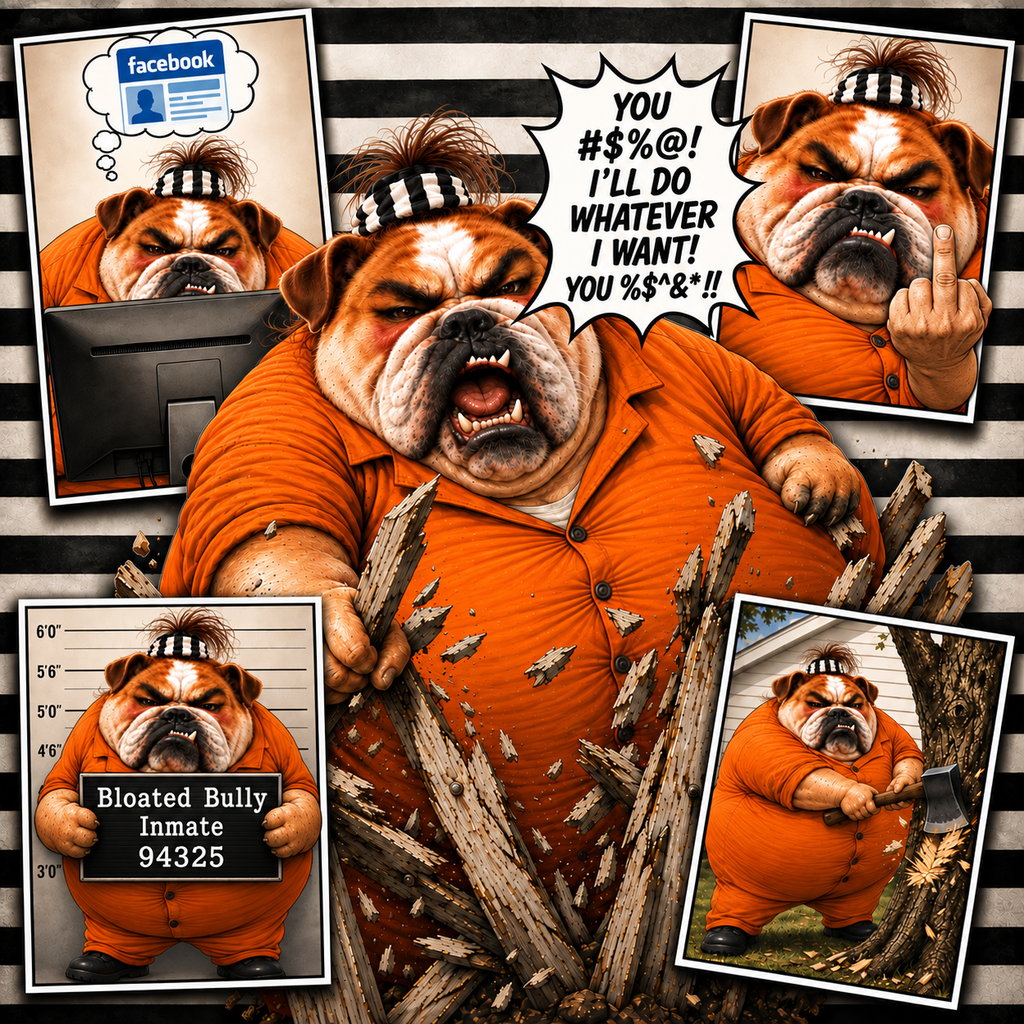
When you live next to a Bloated Bully neighbor like that, the temptation is to spend enormous amounts of energy trying to fix the situation, correct the story, defend yourself, or finally make them understand.
That may be exactly where you start losing.
Because sometimes the best way to deal with a difficult neighbor isn’t to win the argument, or even to win over the neighbors – and critical thinking (or checking court documents) isn’t everyone’s strong suit.
The best way to deal with it all? It’s to make yourself increasingly unavailable for the drama, and hold tight to your at-home peace, no matter what the Bloated Bully or the neighbors say.
Here are seven practical ways to protect your property, your sanity, and—most importantly—your peace.
1. Stop Giving Them the Drama They Love
With a chronically difficult neighbor, unnecessary interaction usually creates one thing:
More material.
More opportunities to argue. More things to misinterpret. More conversations to retell. More facial expressions to analyze. More chances to insist that you were the hostile one because your left eyebrow apparently committed an act of aggression when she drove by – even though her middle finger was waving, and shouting at you.
So stop volunteering.
You don’t need another driveway summit. You don’t need to answer a muttered f-bomb laden comment from across the fence. You don’t need to correct every ridiculous accusation lobbed in your direction.
Practice strategic non-engagement.
That doesn’t mean putting on an elaborate performance in which you dramatically turn your head whenever they appear. That’s still engagement. You’re still communicating.
Instead, become boringly unavailable.
Go get your mail.
Water your flowers.
Walk your dog.
Live your life.
Watch your hummingbirds.
Their presence does not require a response from you.
If you’ve clearly told someone to stop contacting you and their behavior has crossed into repeated unwanted contact or harassment, safety organizations generally recommend avoiding continued responses while preserving evidence of the contact.
Non-engagement isn’t weakness. Sometimes it’s simply refusing to keep buying tickets to a show you hate.
2. When You Have to Communicate, Become a “Grey Rock”
Unfortunately, living next door means complete avoidance isn’t always possible (unless you finally get the restraining order you’ve needed for so long!).
Trees fall (oh, the irony …).
Fences need repair (again — the audacity of me!!).
Packages land on the wrong porch (three times — and never make it back to you or your other neighbor — I’m dying!).
Some issues legitimately require communication.
Enter the grey rock approach.
The basic idea is simple: when someone repeatedly tries to draw you into emotional conflict, make the interaction so calm, brief, and uninteresting that there’s very little to work with.
No essays.
No sarcasm.
No explaining your childhood.
No seventeen-paragraph rebuttal beginning with, “First of all…”
Try:
“Okay.”
“I received your message.”
“I’ll look into it.”
“I don’t have anything else to add.”
“Please send that to me in writing.”
Then stop.
Grey rocking is commonly described as deliberately limiting emotional reactions and keeping interactions neutral when dealing with manipulative or highly conflict-driven behavior. It isn’t appropriate for every situation—particularly where someone’s behavior is escalating or dangerous—but it can be useful when limited interaction is unavoidable.
You aren’t trying to make your difficult neighbor agree with you.
You’re trying to stop feeding the conflict.
Those are two very different goals.

3. Document Everything. Broadcast Almost Nothing.
This one matters.
If strange, threatening, destructive, intrusive, or potentially illegal behavior is happening around your home, keep records. The Bad Neighbor Receipts Binder is a great place to start.
Dates.
Times.
Photos.
Video.
Screenshots.
Witnesses.
Police report numbers.
Damage estimates.
Exact words when they matter.
Keep your notes factual rather than turning them into a diary of what you think the neighbor intended.
Instead of:
“Karen-hating lunatic deliberately tried to terrorize me again!!!”
Try:
“September 12, 8:17 p.m. Individual stood beside east property line for approximately six minutes yelling. Security camera video saved as 9-12-East-Yard.”
Boring?
Absolutely.
Potentially much more useful later?
Also absolutely.
The Stalking Prevention, Awareness and Resource Center (SPARC) recommends incident documentation because a log can help establish a pattern, assess risk, explain what has occurred, and preserve information if someone later decides to involve the civil or criminal justice system.
But here’s the other half:
Your evidence does not need a public-relations department.
You don’t need to send every video to six neighbors.
You don’t need to post a play-by-play on your public Facebook group.
You don’t need to convene a jury during the neighborhood school’s PTA meeting.
Keep your documentation private and protected, sharing it when appropriate with people who actually need it—such as law enforcement, an attorney, your insurance company, a property professional, or another trusted person helping you preserve evidence.
Document.
Don’t campaign.
4. Build Boundaries You Don’t Have to Keep Explaining
Some boundaries are verbal.
The best ones around a difficult neighbor are often made out of wood, vinyl, locks, lights, cameras, curtains, shrubs, and very boring property records.
(Or in some cases, concrete and Trex decking!)
Consider what would make your property less accessible and your daily life less exposed:
- Security cameras covering appropriate areas of your property
- Motion-activated exterior lighting
- Secure gates and locks
- Privacy fencing
- Window coverings
- Landscaping that reduces unwanted lines of sight
- Clearly established property boundaries
If a property line is actually disputed, don’t rely on where someone’s lawn mower historically stopped. Boundary disagreements can require deeds, title records, or a professional survey to determine where the legal boundary really is. Especially if someone tampers with the survery markers.
And before installing cameras, particularly those that record audio or capture neighboring private spaces, check the laws where you live. Privacy and recording laws vary significantly by state, and where a camera points can matter.
The goal isn’t to construct Fort Knox because a Bloated Bully glared at your begonias.
The goal is to create quiet structural boundaries that require less interaction, and provide more protection.
5. Ignore Her Door-to-Door Campaign to Smear Your Name
This one can be brutal.It hurts to be misunderstood, unsupported when you are the actual victim, and spoken badly about – especially by neighbors.
Your Bloated Bully neighbor says something about you that isn’t true. She even puts up her ‘Karen’ and ‘bitch’ signs as “evidence” of how bad *you* are.
Another neighbor suddenly acts differently.
You realize there’s an entire version of events circulating through the neighborhood in which you apparently have the personality of Cruella de Vil and the criminal résumé of a Bond villain.
Of course you want to correct it.
Maybe you even have the police reports and court documents that refute what she’s saying, if people would only ask, or listen.
But ask yourself:
Who genuinely needs this information?
If someone has made a legally significant false accusation, threatened your reputation in a consequential way, contacted your employer, published something damaging, or made statements relevant to an active legal matter, preserve the evidence and get appropriate professional advice.
That’s different.
What you probably don’t need to do is chase every whisper down the street.
Neighborhood gossip has an endless appetite. Every defense can produce a rebuttal, which produces another defense, which produces another conversation.
And suddenly the difficult neighbor isn’t merely living next door.
They’re living in your head rent-free.
The people closest to you probably know who you are.
Reasonable people tend to notice patterns eventually.
And anyone who eagerly accepts outrageous gossip about someone they barely know might not be an audience worth campaigning for anyway.
You don’t have to knock on every door carrying exhibits A through Q.
YES. It makes it infinitely more difficult to walk down the sidewalk of your own neighborhood. I know this feel — trust me. But time will reveal, and Karma is a queen. Let HER do the work for you. It’ll come — eventually.

6. Focus on the Inside of Your Home, and Less on the Neighborhood
This may be the most important thing on this list.
When conflict is happening close to home, it can start changing the way you live.
You peek through the blinds before walking outside.
You listen for their vehicle.
You check the cameras again.
You change when you garden. (Or, give up gardening for two years, altogether, when the screaming and threats became a constant source of anxiety).
You avoid your own backyard.
You hear a noise and immediately wonder whether they’re doing something again.
Little by little, a difficult neighbor can become the unofficial manager of your nervous system.
Fire them.
Your home should contain more evidence of your life than evidence of theirs.
Play music.
Plant flowers.
Put the ridiculous pink flamingo in the yard if you love the ridiculous pink flamingo.
Put up your own signs. I chose a kindness sign, and a “love everyone” sign goes up this weekend.
Invite friends over.
Read on the porch.
Train the dog.
Drink coffee in your pajamas.
Close the curtains when you want privacy—not because you’re hiding.
Use landscaping, window treatments, white noise, outdoor spaces, routines, and whatever else helps you create physical and emotional separation.
Research on stress consistently emphasizes the value of focusing energy on what you can control, including creating a home environment that feels calmer and more manageable.
Don’t spend so much time protecting yourself from the neighbor that you forget what you’re protecting:
your actual life.
7. There is a Difference between “Difficult,” and “Bloated Bully” Neighbors
There is an important line between:
My neighbor is an ass.
and
I may have a safety or legal problem.
Sometimes that difference creeps in between seemingly minor events, and you don’t notice it until there’s a car is swerving at you while you walk down the street.
Repeated unwanted contact, threats, stalking behavior, trespassing, vandalism, property damage, harassment, interference with your property, or behavior that is escalating deserves more than another round of grey rocking.
Depending on what is happening, your next step might involve:
- law enforcement,
- code enforcement,
- your landlord or property manager,
- an HOA,
- a professional surveyor,
- an attorney,
- your insurance company,
- a victim advocate,
- or—in ordinary disputes where both parties can safely participate—a mediator.
Mediation can be useful for some neighbor disputes because a neutral third party can help resolve concrete disagreements without immediately heading into litigation. But serious harassment, stalking, threats, or violence require a safety-first approach, not simply better communication.
This is the distinction I wish more people understood:
Non-engagement does not mean non-action.
You can refuse to argue and file the report.
You can stop responding and save the screenshots.
You can avoid neighborhood gossip and call your lawyer.
You can protect your peace and protect your property.
Those things belong together.
The Goal is to Win Your Peace and Sanity – Not to Live in Her Version of a Neighborhood War
When you’re dealing with a difficult neighbor, it’s easy to start measuring success by whether they finally stop, admit they were wrong, apologize, get exposed, or experience the glorious cosmic boomerang of consequences.
And sure.
Consequences are lovely.
Big fan.
But there’s an even better goal:
They stop controlling so much of your life.
You know where your boundaries are.
You know what you’ll document.
You know what deserves a response and what doesn’t.
You know when something requires outside help.
And the rest of the time?
You go back inside your house and live.
Because however inflated your neighbor’s sense of importance may be, they do not get to be the main character in your home.
That role belongs to you, Karen, and you alone.
